Subscribe to our youtube channel today! @medellin_unfiltered

How to Pay for Everything in Colombia Without Getting Ripped Off
Using the wrong ATM button or paying in U.S. dollars can quietly cost you hundreds during your trip to Colombia. Learn how to use cash, credit cards, ATMs and local payment apps the smart way from someone who's lived in Medellín for more than a decade.
FEATURETECHNOLOGYBUSINESSEXPATS
Steve Hamilton
7/18/202612 min read
The Complete Guide to Accessing Your Money in Colombia (Without Paying Stupid Fees)
There are a lot of ways to waste money on a trip to Colombia, but the easiest one doesn't involve a scam, a pickpocket or a dishonest taxi driver. It usually happens because an ATM or credit card terminal asks you a question you don't fully understand, and you answer it the way most people would.
I can't tell you how many times I've had someone message me after landing in Medellín asking why their bank charged more than expected or why the exchange rate on their receipt looked so bad. In almost every case, nothing fraudulent happened. The bank got paid, the business got paid and the customer walked away with exactly what they purchased. The only problem was that they unknowingly agreed to a terrible exchange rate or paid fees they never needed to pay in the first place.
The frustrating part is that most of it is completely avoidable.
I've lived in Medellín for more than ten years, and my approach to money here has become almost boring. I don't spend time thinking about exchange rates every day, I don't worry about carrying huge amounts of cash and I don't obsess over finding the perfect ATM. I have a system that works, and once you understand how the pieces fit together, you'll probably find yourself doing something very similar.
This guide isn't about squeezing every last penny out of the exchange rate or turning your vacation into a finance class. It's about making smart decisions before small mistakes quietly become expensive ones. Whether you're visiting for a week, spending a few months working remotely or planning a permanent move, the fundamentals are exactly the same.
There are really four ways you'll access your money while you're in Colombia. You'll withdraw cash from ATMs, you'll use a credit card for most larger purchases, you may decide to use local payment apps if you're staying for a while, and you'll want a backup plan in case something goes wrong. Each one serves a different purpose, and once you understand where each one fits, managing your money in Colombia becomes surprisingly straightforward.
Let's start with cash, because despite everything you've probably heard about digital payments, it still has an important role to play.
Cash Isn't Dead. It Just Has a Different Job
One of the biggest changes I've seen since moving to Medellín is how much easier it has become to pay with a credit card. Walk into Éxito, Carulla, Jumbo, almost any shopping mall, chain restaurant, pharmacy or hotel and you'll have no problem using a Visa or Mastercard. Contactless payments are becoming increasingly common, Apple Pay and Google Wallet are slowly gaining traction, and Colombia's payment infrastructure has come a long way over the last decade. That doesn't mean cash has disappeared. It simply has a different job now.
You might pay for lunch with your credit card, then walk outside and buy a fresh mango from a street vendor who only accepts cash. Later you stop at a neighborhood bakery for an empanada, tip the guy watching motorcycles outside the restaurant or wander through an artisan market where several vendors still prefer bills over plastic. None of those purchases are large, but they're part of everyday life here, and having a little cash in your pocket makes everything easier. The mistake I see tourists make is assuming they need to carry a lot of it.
Personally, I usually have somewhere between 20,000 and 50,000 pesos in my wallet, and that's enough for almost any normal day. If I know I'm heading somewhere that relies more heavily on cash, I'll stop at an ATM on the way. They're everywhere in Medellín, so I don't see much value in carrying several hundred thousand pesos around just because I might need it later. The less cash you carry, the less you have to think about it.
People also tend to overthink getting their first pesos. One of the most common questions I receive is whether it's better to exchange money before leaving home or simply wait until arriving in Colombia. My answer is almost always the same: wait.
That said, I do think there's one exception, especially if this is your first trip to Colombia.
If having a little cash in your pocket before you land helps you relax, then order a small amount of Colombian pesos from your bank before you leave home. Most major banks in the United States can order foreign currency for you, although it usually takes a few business days. I wouldn't exchange your entire vacation budget this way because the exchange rate typically isn't as favorable as withdrawing pesos once you arrive, but having 100,000 to 200,000 pesos in your wallet when you step off the plane can make those first few hours much less stressful.
There's something reassuring about knowing you already have enough local currency for a coffee, a snack, a taxi or any small expense that comes up before you find your first ATM. You won't feel pressured to use the first exchange counter you see in the airport, and you won't be standing there wondering if your debit card is going to work after an overnight flight. Think of it as buying yourself a little peace of mind. Once you're settled in, you can use ATMs for the rest of your trip and usually come out ahead.
Airport exchange counters aren't necessarily trying to rip you off. They're charging for convenience, and convenience almost always comes at a price. You've just stepped off a long flight, you don't have any local currency and they know you're willing to pay a little extra to solve that problem immediately. Currency exchanges back home operate much the same way. By the time Colombian pesos have been purchased, shipped internationally and made available through your local bank or exchange business, those costs have already been built into the exchange rate you're offered.
One thing that is important to mention, if you are in the touristy areas of Poblado and Laureles, or anywhere for that matter, NEVER PAY FOR ANYTHING IN YOUR LOCAL CURRENCY. NEVER.
I've consistently found it cheaper and simpler to arrive with a quality debit card and withdraw pesos after I land. It removes the guesswork of trying to estimate how much cash you'll need before the trip even starts, and in most cases you'll receive a much better exchange rate than you would at an airport exchange counter.
Of course, that raises another question, if you're going to use an ATM, which one should you trust?
Using ATMs Without Getting Ripped Off
I don't spend much time searching for the "best" ATM because, honestly, there isn't much reason to. I stick with the same handful of major Colombian banks and I've had consistently good experiences with all of them. Bancolombia, Davivienda, BBVA and Scotiabank Colpatria all have extensive ATM networks throughout Medellín, and chances are you'll run into one of them within a few minutes of wherever you're staying.
Whenever possible, I also use ATMs inside shopping malls or attached directly to bank branches. It's not because every standalone ATM is dangerous. It's because busy locations tend to have better lighting, more foot traffic and, in many cases, security guards nearby. Good habits don't eliminate risk, but they usually stack the odds in your favor.
Before inserting your card, take a quick look at the machine. Does the card slot look loose? Is there anything attached that doesn't seem like it belongs? Does the keypad feel unusual? Card skimming isn't unique to Colombia, and it isn't something you should lose sleep over, but spending five seconds inspecting the machine is a habit worth developing no matter where you travel.
The ATM fee itself is another topic that gets more attention than it deserves. Yes, Colombian banks charge withdrawal fees, and those fees vary depending on the institution. Personally, I don't spend much energy chasing the cheapest ATM because my debit card reimburses those fees anyway. If your bank doesn't, then it's worth paying attention, but even then the withdrawal fee usually isn't what costs travelers the most money.
The real damage happens a few screens later. Almost every tourist eventually runs into a screen asking whether they'd like to accept the ATM's currency conversion. The wording changes depending on the bank, but the offer is always the same. The machine promises to show you exactly how much the withdrawal will cost in your home currency instead of Colombian pesos.
To someone who has never seen that screen before, it sounds like a helpful feature. In reality, it's one of the most expensive buttons you'll press during your trip.
The ATM Screen That's Quietly Costing Tourists Money
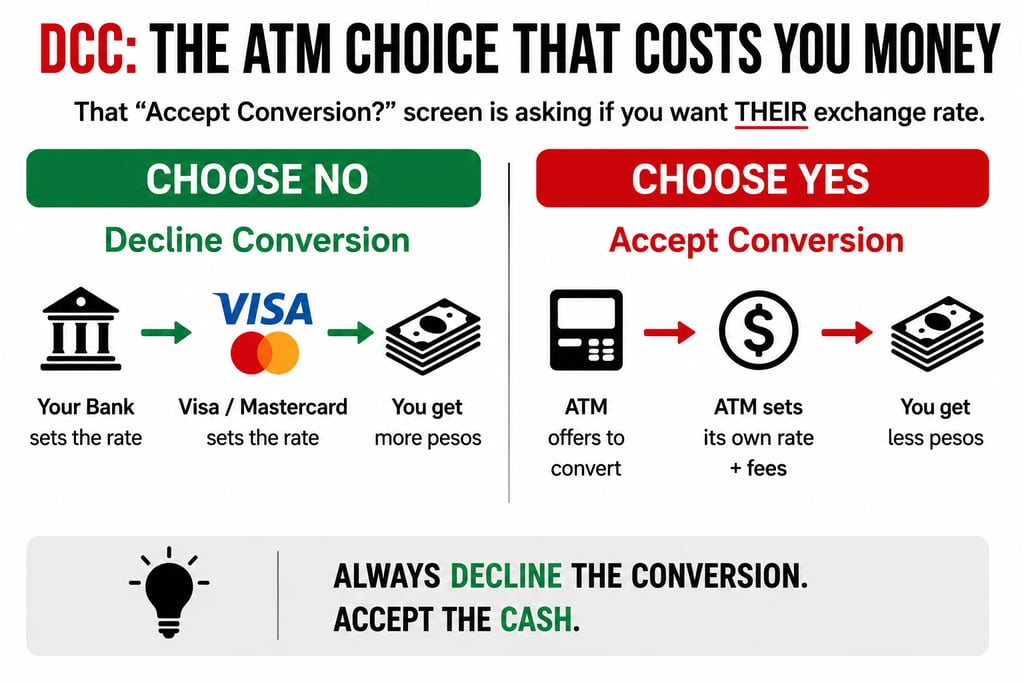
Almost every ATM in Colombia will eventually ask whether you'd like to accept its currency conversion. The wording changes depending on the bank, but the question is always asking the same thing: "Would you like us to convert this transaction into your home currency?" It sounds like a helpful feature. In reality, it's one of the easiest ways to overpay during your trip.
This is called Dynamic Currency Conversion (DCC), and despite the complicated name, the concept is surprisingly simple. Instead of letting Visa, Mastercard or your bank convert your dollars into Colombian pesos, you're giving the ATM permission to do it instead.
The problem is that the ATM isn't offering this service out of kindness. It's offering it because it makes money on the exchange rate. Think of it this way. If you walk into a currency exchange shop, you expect the business to make a profit somewhere. The ATM is doing exactly the same thing. By accepting its conversion, you're allowing that ATM operator to become your currency exchange company, and they're free to use an exchange rate that's more favorable to them than it is to you.
That's why the rule is so simple.
Decline the conversion. Accept the cash.
You're not declining your withdrawal. You're declining their exchange rate.
I know the wording can be confusing because the screen almost makes it sound like you're rejecting the transaction altogether. You're not. The withdrawal will still go through. The only difference is that your bank or card network handles the currency conversion instead of the ATM.
Over the years I've seen countless screenshots from readers asking why their withdrawal seemed so expensive, and more often than not, this is the reason. They weren't charged a ridiculous ATM fee. They simply agreed to a poor exchange rate without realizing it. It's one button, but over the course of a two-week vacation it can easily cost you enough money to pay for a nice dinner, a coffee tour or a day trip to Guatapé.
While we're talking about debit cards, it's also worth mentioning that not all of them are created equal. My favorite has been the Charles Schwab Investor Checking debit card because it reimburses ATM fees worldwide. If the ATM charges you for a withdrawal, Schwab refunds those fees automatically at the end of the month. If you're military or a veteran, Navy Federal and USAA are also excellent choices that many travelers already have.
The goal isn't to find the perfect ATM. It's to stop giving away money after you've already found one. Fortunately, the exact same principle applies when you pull out your credit card.
Credit Cards Are Your Best Friend... If You Use Them Correctly
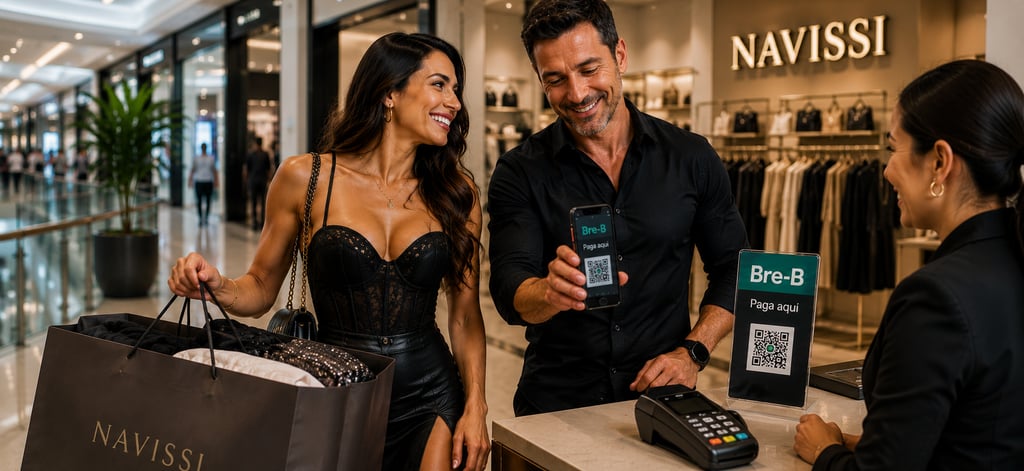
For most visitors, your credit card is going to be the payment method you use more than anything else. I use mine constantly. Restaurants, grocery stores, hotels, shopping malls, pharmacies and coffee shops all accept cards without any issue, and I honestly carry less cash today than I did five years ago because I simply don't need it.
One thing Americans often notice right away is that your credit card usually never leaves your sight. Instead of disappearing into the back of a restaurant, the server almost always brings a wireless payment terminal directly to your table. You tap, insert or swipe your card, the transaction is approved, and you're done. It's a small difference, but it's one of those little things that makes paying here feel surprisingly modern.
Then the terminal asks a familiar question.
Would you like to pay in Colombian pesos or U.S. dollars?
If you've made it this far in the article, you probably already know the answer. Choose Colombian pesos. Every time. This is Dynamic Currency Conversion all over again, except now it's happening through the payment terminal instead of the ATM. If you choose U.S. dollars, the payment processor converts the purchase using its own exchange rate. Just like the ATM, they're making money on that conversion.
I actually kept one of these receipts because it perfectly illustrates what's happening behind the scenes. The purchase wasn't unusual, but the terminal added a seven percent commission while using an exchange rate that was dramatically worse than what my card network would have provided. On a single transaction it wasn't catastrophic, but that's not how these fees work. They compound.
A few dollars at dinner. A few more at your hotel. Another few while shopping. By the end of the trip you've spent a surprising amount of money for absolutely no benefit. Always choose Colombian pesos and let your bank handle the conversion instead.
Before you leave home, it's also worth checking whether your credit card charges foreign transaction fees. Many of the better travel cards don't charge them at all, but plenty of banks still add an extra three percent to every international purchase. That's money you don't need to spend. Visa and Mastercard are accepted almost everywhere in Colombia. American Express has expanded considerably over the years, but you'll still run into businesses that don't take it, especially outside major cities. Discover is even less common, so I wouldn't rely on it as your primary card. Once you've got your debit card and credit card sorted out, you're in good shape for a normal vacation.
If you're planning to stay longer, though, there's another option that's changed the way I manage my money here.
Why I Started Using Local Payment Apps
When I first moved to Medellín, this section wouldn't have existed. Today, it's become part of my everyday routine. If you're coming to Colombia for a week, you probably don't need to overcomplicate things. A good debit card, a credit card with no foreign transaction fees and a little cash will handle almost everything. Long-term stays are different.
When you're living here, paying rent, buying groceries and moving money back and forth regularly, local payment apps become incredibly convenient. They've removed a lot of the friction that used to come with managing money across different countries. The two I use most are ARQ and WanderWallet.
I like ARQ because it gives me another simple way to move money into Colombia without constantly relying on ATM withdrawals. It's become one of those apps I don't think much about anymore because it simply works.
You can check it out here if you want to see whether it's a good fit for your situation:
ARQ
https://www.arqfinance.com/referrals/general?referralCode=stevehamilton_rxK&pid=referral&c=general
I've also been using WanderWallet, particularly because it's built around travelers and expats who need an easier way to spend money while they're abroad. If you're planning an extended stay in Colombia, it's worth looking into.
You can sign up using my referral link below, and you'll receive a $5 bonus after joining.
WanderWallet
https://activate.wanderwallet.io/medellinunfiltered
I wouldn't tell someone visiting Medellín for four days that they absolutely need either of these apps. I would tell someone staying for three months to spend an hour looking into them. That's a very different conversation. Of course, even the best financial setup doesn't eliminate bad luck.
Have a Backup Plan Before You Need One
Banks flag transactions. Cards get lost. Wallets disappear. ATMs occasionally decide they're keeping your debit card. It happens. That's why I never travel with a single way to access my money. I carry a backup credit card, keep it separate from my primary wallet and stash a small amount of emergency cash where it isn't sitting in the same pocket as everything else. If something does go wrong, services like Remitly can be incredibly useful. Hopefully you'll never need it, but if someone back home has to get money to you quickly, it's one of the easiest ways to make that happen.
If you'd like to use it, here's my referral link:
Remitly
https://remit.ly/wdyknfc3
After more than a decade in Medellín, my wallet has become surprisingly simple. I carry 20,000 to 50,000 pesos for everyday purchases, a debit card for ATM withdrawals, a credit card for almost everything else and a backup card that stays out of sight unless I actually need it. ARQ and WanderWallet have become part of that system because they solve problems that used to require extra trips to the ATM or unnecessary bank transfers. None of those tools is remarkable by itself. Together, they make accessing money in Colombia almost effortless.
Final Thoughts
One of the biggest myths about traveling to Colombia is that you need some complicated financial strategy before you arrive. You don't. You need a little cash for the places that still rely on it. You need a solid debit card for ATM withdrawals. You need a credit card without foreign transaction fees, and you need to remember one simple rule every time a screen offers to convert your money for you.
Let your bank do the conversion. Not the ATM. Not the payment terminal. Everything else is just details.
Colombia is one of the best values you'll find anywhere in the Americas. The food is affordable, transportation is inexpensive, and it's still possible to have an incredible experience here without spending a fortune. Don't let avoidable banking fees become one of the most expensive parts of your trip. Spend that money on a better meal, another weekend exploring Antioquia or one more cup of Colombian coffee. You'll remember those a lot longer than an ATM fee.

Medellin Unfiltered
Discover the real Medellin, without filters.
CONTACT US
info@medellinunfiltered.com
© 2024 GWM Ventures. All rights reserved.
LEGAL