Subscribe to our youtube channel today! @medellin_unfiltered

Why Are Old Credit Card Charges Reappearing In Colombia?
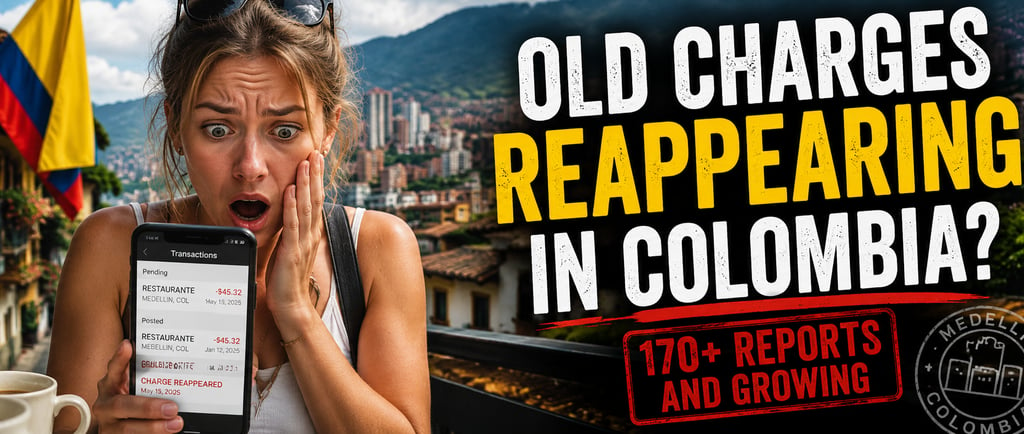
Over the past week, roughly 170 foreign cardholders reported seeing old transactions suddenly reappear on their credit card statements in Colombia. After reviewing reports from multiple countries, banks, and merchants, Medellín Unfiltered investigates what happened, what payment processors are saying, and what travelers should know.
BUSINESSTECHNOLOGYSAFETYEXPATS
Steve Hamilton
5/30/20265 min read

Why Are Old Credit Card Charges Reappearing In Colombia?
💳 Roughly 170 foreign cardholders reported old transactions suddenly reappearing on their statements.
🌎 Reports span multiple countries, at least 14 banks, and numerous cities across Colombia.
🏦 Credibanco says certain DCC transactions required an operational adjustment and denies fraud.
❓ Key questions remain about timing, notification, and how consumers can verify the charges.
🇨🇴 Foreign travelers should understand the difference between choosing pesos and dollars when paying in Colombia.
Over the past week, I've received roughly 170 reports from viewers who noticed something unusual on their credit card statements. A charge they thought was long settled suddenly appeared again months later. At first glance, that might not sound particularly alarming. Banks make mistakes. Payment systems have glitches. People occasionally forget purchases. If this had been a handful of reports from one bank or one merchant, I probably wouldn't be writing about it. But the deeper I dug, the harder it became to dismiss. The reports came from Americans, Canadians, Europeans, Panamanians, and travelers from several other countries. They involved at least 14 different banks, multiple cities across Colombia, and a wide variety of merchants ranging from grocery stores and restaurants to bars and retail shops. What they appeared to share was something much more specific. Most of the affected transactions involved foreign-issued cards that settle in U.S. dollars. That doesn't automatically tell us what happened, but it does tell us where the questions should be directed.
The Merchants Don't Appear To Be The Story
One thing became clear fairly quickly. There is currently no evidence suggesting local businesses are responsible. Many of the reports involve ordinary purchases at places people visit every day. Some were grocery stores. Some were restaurants. Some were cafes. In several cases, merchants have reportedly confirmed they are not receiving any additional funds related to the adjustments. That's important because frustrated consumers often direct their anger toward the business where the purchase occurred. Based on everything I've reviewed so far, that appears to be the wrong target. The questions seem to sit much further upstream in the payment process. In fact, one of the strongest patterns emerging from the reports is that the businesses themselves often seem just as surprised as the cardholders.
Credibanco's Explanation
As reports continued to surface, a communication from Credibanco began circulating online. According to the company, certain Dynamic Currency Conversion transactions processed between January and May contained discrepancies. Credibanco stated that some cardholders were charged less than the amount originally authorized and that a correction process was later implemented. The company also stated that merchants were not affected and that this was not a fraud event. That explanation deserves to be presented fairly because any serious investigation should consider all available information. At the same time, it raises several questions. If the discrepancy existed, when was it discovered? Why did it take months to correct? How can cardholders independently verify that the corrected amount matches the original authorization? Why were consumers not proactively notified before adjustments began appearing? Those questions remain unanswered and, regardless of where this story ultimately leads, they deserve clear responses.
The Pesos Or Dollars Question
If you've spent time in Colombia, you've almost certainly encountered a payment terminal that asks a simple question: "Pesos or Dollars?" Most travelers answer without thinking twice because they're standing in a checkout line, paying for dinner, grabbing groceries, or simply trying to get on with their day. In reality, that choice can have a significant impact on how a transaction is processed. When you choose pesos, the transaction remains in Colombian pesos and your card network typically handles the currency conversion. When you choose dollars, a process known as Dynamic Currency Conversion, or DCC, may be used instead. For years, experienced travelers have generally advised selecting the local currency when making purchases abroad. In Colombia, that means choosing pesos. That's why the DCC explanation immediately caught my attention. Many of the reports involve foreign-issued cards, which is exactly the type of card DCC systems are designed to recognize. Whether that ultimately explains everything remains to be seen, but it is difficult to ignore the fact that foreign-issued dollar-settled cards appear repeatedly throughout the reports I've reviewed.
The Real Question
What makes this story interesting isn't necessarily the amount of money involved. For many people, the adjustments appear relatively small. The bigger issue is expectation. Most consumers believe a retail card transaction becomes final after it settles. You buy groceries, grab dinner, pay your statement, and move on with your life. The idea that an everyday purchase from months ago can suddenly become relevant again feels surprising because most people never realized it was possible. That's where much of the public concern appears to originate. People aren't just asking where the money went. They're asking how the system works. They're asking what authority exists to revisit completed transactions. They're asking whether this can happen again in the future. Most importantly, they're asking whether they would have known any of this was possible had these adjustments never appeared in the first place.
Seeking Answers
As the reports continued to arrive, I reached out directly to both major payment processors involved. My goal wasn't to accuse anyone of wrongdoing. It was simply to understand what happened and provide viewers with accurate information. Both companies declined to comment. A company choosing not to comment does not prove wrongdoing, and it's important not to jump to conclusions. At the same time, the lack of detailed public explanations leaves many consumers searching for answers on their own. One processor has already acknowledged that an operational adjustment occurred, but many of the most important questions surrounding timing, notification, and verification remain unresolved. That's why I believe this story deserves attention. Not because we already know what happened, but because we still don't.
What Foreign Cardholders Should Do
If you're a foreign cardholder who spends time in Colombia, there are a few practical steps worth taking. Review your recent statements carefully and compare them against any receipts you may still have. If you notice an adjustment that doesn't make sense, contact your bank and request a written explanation. Document dates, amounts, transaction details, and any case numbers associated with your inquiry. Most importantly, avoid assumptions. The facts matter more than the theories. Right now, there is a tremendous amount of speculation circulating online, and the fastest way to separate fact from fiction is through documentation and evidence. The more information consumers gather, the easier it becomes to understand the true scope of the issue.
How Can I Protect Myself?
This may be the best ad ever for the ARQ card (formerly DolarApp) Here is our link: https://www.arqfinance.com/referrals/general?referralCode=stevehamilton_0FC Use this link and sign up and when you spend $100 you'll get $20 back.
The Bottom Line
After reviewing approximately 170 reports, one thing is clear: something happened. The remaining debate centers on scope, timing, transparency, and explanation. Maybe the processors are completely correct in their assessment. Maybe there are details consumers still haven't been given. Either way, foreign cardholders deserve a clear explanation they can understand. What began as a handful of isolated reports has developed into one of the most talked-about consumer finance stories among foreigners living in and visiting Colombia. Whether this ultimately proves to be a technical correction, a communication failure, or something else entirely, the underlying question remains the same. Why are people seeing activity today on transactions they believed were finished months ago? Until that question is fully answered, the story is far from over.

Medellin Unfiltered
Discover the real Medellin, without filters.
CONTACT US
info@medellinunfiltered.com
© 2024 GWM Ventures. All rights reserved.
LEGAL